Sunday, 4 July 2021

Sunday July 4th 2021

09:30 Lois and I are up early again to do our weekly zoom call with our younger daughter Sarah, who lives just outside Perth, Australia, with Francis and their 7-year-old twins, Lily and Jessie.

It's easy for Lois and me to forget that it's winter over there. Today Sarah says the whole family has colds, and are feeling a bit rough, so we make it a shortish zoom call. Luckily the school term has just finished, so the girls have the prospect of three weeks' holiday in front of them, which is nice. 

The twins turn 8 on July 25th, which will be the last day of the holidays: not a good day for inviting their friends round for a birthday party, so Sarah says they'll be postponing the party till the following weekend.

Lois and I are up early, but a bit bleary-eyed, to do our weekly zoom call
with Sarah and family in Perth, Australia

Lily shows us her birthday wish-list: 

I take a picture of Lily's birthday wish-list, and later we try reading it, but some of the items are unclear - damn! We can see "blue cushion, squishy (?) marshmallows, gem stones, magic [something], swimming costume, pokemon cards, chalk, charm bracelet tin, gigantic fluffy [something].  How sweet they are !!!

The twins are very imaginative, to put it mildly, and very good at making their own amusements. They love their children's encyclopaedia - they may perhaps have inherited that trait from me: I used to take an encyclopaedia and an atlas to bed with me, I'm shy to admit. The twins like to have "fun with flags", and they've been making their own models of flags using coloured "Lego" bricks. 

Sarah says there are still a few restrictions in place in Western Australia - a total of five people in the state have tested positive for COVID: all these infections were linked with the outbreak in New South Wales. 

Francis says the outboard motor for the 20 foot sailing boat the family bought recently has now arrived, so he'll be getting busy soon with getting the boat ready for use in the spring.

While the zoom call has been in progress, Jessie has sent me a text on Mummy's phone, including a photo of two kangaroos she saw in their backyard.

two kangaroos that Jessie spotted in their backyard
- note the upturned feeding bowl: Sarah says if they put
any food down for the kangaroos, it soon disappears!

Lois and I think those two kangaroos are asking for "second helpings". A bit like Oliver Twist's "Can we have some more please sir?". How cute !!!!!

Sarah and the twins aren't feeling that bright today, because of their colds, and Sarah has a big week ahead of her starting tomorrow in her accountancy job - the end of the tax year. So we let them go, so Sarah can get the pancakes ready for the girls' tea - yum yum!

16:00 An interesting email comes in from Steve, our American brother-in-law, all about the UK's pre-decimal currency. It's so nostalgic for me because this was our official UK money until I was 25 years old, and as children we used to spend such a lot of time emptying our money boxes and counting out the "pocket money" we'd accumulated.

There used to be 12 pennies/pence in a shilling, and 20 shillings in a 'pound', so called because it weighed a pound: that was the main gist of it. The system was devised by Charlemagne, and held good over most of Europe at the time.

Lois and I are reminded of the old coins every time we look at the clock in our sitting-room, which has examples of all the main old coins around the clock face.

the UK's pre-decimal coinage

Reading clockwise starting from "12 o'clock", we have the half-crown (2 shillings and 6 pence), a threepenny bit, a really old halfpenny (Queen Victoria), a farthing (1/4 of a penny), a penny, a sixpence, a florin or two-shilling bit, and a shilling. We bought the clock in St Ives, Cornwall about 30 years ago, and it's still going strong. I remember how those huge old pennies used to weigh down your pocket and make holes in it - what madness !!!

I think the Australians were the first in "The Empire" to "go decimal", in the 1960's. The UK took the plunge in 1971 under Prime Minister Ted Heath - he did it while I was spending my year in Japan. I remember I came home from Japan in August 1971, with a cheap Japanese cassette player. The mean-spirited HM Customs officer said he was going to charge me £4 duty on it, so I wrote him a cheque: but I wrote "£4-0-0" in the old style, and he made me cross that out and write "£4.00" in the new style. 

What a crazy world we live in!!!!

Memories, memories - happy days !!!!!

17:00 It hasn't been widely reported in the UK news media (haha) but in the Euro 2020 soccer knock-out competition, the England team has progressed to the semi-finals: they beat Ukraine 4-0 in Italy last night. 

In the semi-finals England will face Denmark. Don't ask me who's likely to win that one - I don't know much about soccer, to put it mildly. But it's an interesting situation for our daughter Alison and her family in Headley, Hampshire. 


Alison's family spent 6 years in Copenhagen from 2012 to 2018 and they have a lot of Anglo-Danish friends, including Anglo-Danish mixed-married couples etc. Some of these couples will reportedly be suffering from conflicting loyalties on Wednesday when the two teams meet at Wembley.


Oh dear! But I suspect it will only become an issue for couples if the marriage is in trouble already - at least that's what Lois thinks, and I'm inclined to agree with her. Oh dear, oh dear, oh dear! Thank goodness Lois and I don't really take much interest in soccer, that's for sure!

20:00 We watch a bit of TV on the couch, the latest edition of "Countryfile", a magazine show based loosely on news from the countryside in various parts of the UK.

Lois and I didn't know that Wimbledon Common was "a thing" - we thought it was just a bit of spare land round London that nobody had thought of building on yet. But apparently it was set up 150 years ago, as an 1140 acre "site", with its own set of by-laws and a team of rangers and a "keeper" to "police" it. Who knew that? [I expect a lot of people knew that - Ed]

Presenter Matt Baker and the current "keeper" go for a ride on two of the rangers' white horses over the Common, and the keeper explains to Matt about the by-laws, many of them 150 years old, but still in force. 

Apparently you're not allowed to beat your carpet there, or to hang out washing. And if you play golf (which seems a bit dangerous to us anyway) you have to wear red, so people can see you coming. What madness !!!!!


What a crazy world we live in !!!!!!

Later in the programme veteran broadcaster John Craven announces the start of the programme's annual "Photography Competition", where viewers are invited to send in their best photos of nature and natural phenomena in the UK. It's the competition's 30th anniversary this year, so they hoping to get a bonanza of stunning photos, John says. The 12 winners get a cash prize and their photos will appear in the show's Charity Calendar for 2022.


I try to persuade Lois to enter her recent sensitive photographic study "The Bashful Bee", but she seems reluctant. But we'll see, I may be able to talk her round in the end!

flashback to July 1st - Lois's sensitive 
photographic study "The Bashful Bee"

And who can forget Burl Ives's haunting song about Barney the Bashful Honey-bee?

Barney was a bashful honey-bee - his heart was full of grief

All day long he sat upon his great big leaf

Now Barney never had a girl because he was too shy.
So when evening rolled around, the tears would dim his eyes
and he’d go.... 

"Buzz buzz buzz buzz"

Buzzing all night long

"Buzz, buzz, buzz, buzz"

 It was a lonesome song

They don't write them like that any more!!!! [Thank god for that! - Ed]

22:00 We go to bed - buzzzzzzzzzzzzzzz!!!!


Saturday, 3 July 2021

Saturday July 3rd 2021

Not a good day! We make a bad start by backing down from our resolution to stop wiping down with disinfectant the groceries delivered to us by Budgens, the convenience store in the village. 

a typical way of wiping down groceries - why do we keep doing it???
Does it say more about us than it does about the virus????

Lois doesn't want to take any risks, even though scientists say there's no risk. Plus we've sort of got into the habit of doing it now, so maybe it's simpler to continue - what madness !!!!! Perhaps we'll be doing it for the next 10 years - if we're lucky haha!!!

flashback to last Sunday - the helpful Canadian study
pointed out to us by Steve, our American brother-in-law

Later (about 12 noon) we have a near-death experience in Bishops Cleeve, the small town 3 miles north of Cheltenham. Some people say that the mere fact of living in Bishops Cleeve is a near-death experience, but we reject that idea - we like quiet neighbourhoods! We are driving along Station Road on a trip mainly designed to give our car a bit of "exercise", when a police car comes round the bend in front of us and we have to quickly swerve to the left and drive onto the pavement to get out of the way - yikes!

Station Road - a bit of a bendy road, and we weren't
expecting a police car coming in the opposite direction
round one of the road's frequent bends. What madness -
there hasn't been a crime committed in Bishops Cleeve since 1792 !!!!

We survive the near-death experience and reach home in time to have a cup of coffee on the patio.

we survive the near-death experience, and suddenly
life seems more precious haha!

We're just a couple of old codgers, so TV is a big factor in our life. Unfortunately at the moment TV is  mostly wall-to-wall sport, what with Euro football, Wimbledon, Rugby and the Tour de France. Andy Murray and somebody else British have now been knocked out of Wimbledon, so there should be less interest in the tennis from now on, which is nice.

Saturday's TV highlights - what madness !!!!
[That's enough madness, settle down now! - Ed]

15:00 An annoying brush with Amazon on my part. I order a small can of WD40 to spray on our washbasin's pop-up stopper, which pops up well enough but doesn't "pop down" - damn it! Lois has had the brainwave of putting a small yellow plastic basin under the taps to collect the water when we've washing our hands etc.

our washbasin stopper still pops up, 
but it doesn't pop down any more - an embarrassing problem
for anybody haha! But Lois today thought of putting a plastic
basin in there - sheer genius !!!

I can't complain about Amazon's speed in processing my order - the WD40 will be coming tomorrow, even though it's a Sunday. But that's probably mostly because I mistakenly signed up for a free trial of Amazon Prime when I was putting in my order. 

Damn, damn, damn! Every time I order something from Amazon they try to get me to sign up for Prime, and this time I must have done something wrong, because I ended up actually agreeing to Prime.  Damn (again) !!!!

I've cancelled my Prime membership, but it will still be valid till August 2nd.


What was it Paul McCartney sang?

"I clicked something wrong,
Now I long
For yesterday"

I have yet another unfortunate brush with Amazon later this morning. We want to send our twin-granddaughters in Perth, Australia, a dominoes game, so I order it from the so-called "Australian Amazon" (amazon.com.au). But first of all there's a lot of messing about with my password. 


In my little book I've always had a separate password for the Australian Amazon from my UK one. But I think they must have standardised passwords between the 2 sites, because first of all Australian Amazon reject the password I've used before, so I spend a lot of time changing it. Then when I come to log on to the UK Amazon, I realise that the UK site will now only accept my Australian password.

In the end I wish I hadn't bothered. The so-called Australian Amazon still ships most of its merchandise either from the UK or from the US, so you don't save any money on shipping costs, which is a bummer, to put it mildly!

What a crazy world we live in !!!!!

16:00 We have a cup of tea and a currant bun on the sofa. Lois reads me bits out of her copy of "The Week", which gives a digest of the week's news from around the world. The copy has today emerged from its compulsory 24 hours quarantine on the hall floor. [Don't say it! - Ed]

this week's copy of  "The Week"

It's interesting, Lois tells me, that for all the talk of a "United Ireland", it's apparently never going to happen: the Irish Republic could never afford it, apparently. 


The UK spends £10 billion a year on keeping the North afloat - the old heavy industries, like shipbuilding for instance, have long ago collapsed and a third of all workers are employed in the public sector. But the Republic would never be rich enough to carry this burden. 

Lois also tells me an interesting story about office occupancy in New York - it's still only at 25% apparently due to the continuing practice of working from home. Even Philadelphia is only at 30%.


If companies decide they don't need their big office blocks any more, and decide to shed them, that's going to hit the finances of city governments of course. Something similar is happening in the UK. And while companies look ahead to the inviting prospect of being able to save money on taxes, fuel bills etc, it'll be the employees working from home that will have to heat (or cool) their homes 24/7, although they won't have to pay for quite so much travel. It's a bit of a social revolution isn't it, to put it mildly.

17:00 Our daughter Alison, who lives in Huntley, Hampshire, with Ed and their 3 children has put an interesting picture up on Facebook of some of the books her eldest child Josie (14) will have to read for her high school GCSE English course starting in September.

Josie's reading list - note that Daphne du Maurier's "Rebecca"
appears twice, once on each shelf, but Alison assures
us the Josie will only have to read it once haha

But oh dear they certainly put you through it if you take English these days - my god!

20:00 We watch a bit of TV, the latest programme in Andrew Marr's series on "Great Paintings of the World".


In general I don't really care much for "abstract art" or "modern art", but I make an exception for Picasso's "Weeping Woman", which certainly expresses the woman's grief, there's no doubt about that. It was inspired by Picasso's own mother's weeping after the brutal Nazi bombing attack on the Spanish town of Guernica in 1937 - it was a so-called "experiment" by Hitler to see how much damage aircraft could do to a town by bombing raids alone: 70% of the town was destroyed, and a third of the population killed.

Picasso's "Weeping Woman" (1937): 

Note how the 'warm' colours in the background contrast with some of the 'cold' colours of the woman's face; note also her teeth - teeth rarely appear in artwork, strangely.

Lois and I didn't know, or had forgotten, that this painting was quickly bought up, for £284, by Picasso's friend, private art collector Roland Penrose, who brought the picture back to hang his flat in London. So it disappeared from public view, as far as the art world was concerned, for over 30 years.

In 1969 it hid the headlines again when Penrose's flat was burgled and the picture stolen. Eventually it was discovered in a second-hand shop and was then donated by Penrose to the Tate Gallery. So all was well in the end.

April 1969 - report of the theft in the Daily Telegraph

three months later the picture was found "in the rubbish" at a shop - my god!
(report in the Daily Mail)

22:00 We go to bed - zzzzzzzz!!!!!


Friday, 2 July 2021

Friday July 2nd 2021

10:15 My sister Gill in Cambridge texts me. She recently discovered a mystery close relative, David, that nobody in our family knew about. He's a BBC online journalist who was adopted as a child, and as far as we know, he didn't know anything about his blood relations, until this connection with Gill came to light.

Gill discovered the connection with David only after she sent her DNA in to a large database. My wife Lois and I, and Gill herself, have all been doing some research online and we believe we have found a family of 7 adopted children, one of whom we think is David's half-brother, which David will probably be very interested to know about.

David has now told Gill he has some more information for her, and wants to speak to her by telephone. How exciting - what will be revealed next, we wonder.

Isn't DNA wonderful! Who would want to study anything else haha!

a typical piece of DNA (left)

10:30 The max temperature today is going to be 75F (24C) - phew, what a scorcher! The morning goes like a flash for Lois and me - we do a walk on the local football field taking with us our smart shiny new e-mugs (reusable), which we use for a coffee (me) and a hot chocolate (Lois) at the Whiskers Coffee Stand. It's reasonably quiet on the field, with only dog-walkers for company - what the Danes call "dog airers" haha!

Lois is wearing her fetching Australian sun-hat that our twin
grandchildren in Perth - Lily and Jessie - bought for her


some of the typical dog-walkers we see on the field today

11:30 We come home. There's been no rain for a few days, so we have to keep watering our enormous garden and greenhouse a lot, so I set to work refilling our water-butts from the kitchen tap. It's the ideal gardening "job" in my view - not too demanding, and quite relaxing: I just have to drag the garden hose down to the water butts, turn on the tap and watch the water level going gradually up. 

I supervise the filling of one of our water butts

As I watch the butt filling up, I remember with nostalgia Carson Robison's hit country song "Life Gets Teejus, Don't It" (1948) with its upbeat message:

Water in the butt’s gettin' higher an' higher.
I can take a bath every night or more,
But I've heard it said, and it's true I'm sure,
That too much bathin'll weaken you.

Wise words indeed!

14:30 Time for a quick post-lunch nap and then it's time for me to take part in Lynda's U3A Middle English group's monthly meeting on zoom. We hear the second part of Cynthia's presentation on the influence of French on Middle English.

one of Cynthia's slides from her presentation 

We have lots of fun during the presentation, especially when we hear about some of the awful French or pseudo-French loan words that luckily haven't survived into modern English, like "refeffement", a legal term which apparently meant "the action of resettling property on one who had previously held it". 

What madness !!!!

During Cynthia's presentation I get the opportunity to show off my knowledge of how Hungarian is pronounced, which is nice. Cynthia was explaining the theories of a Hungarian linguistics pundit called Ősi, whose name she doesn't know how to say - I am able to reveal (exclusively) that it is pronounced in a similar way to how an h-dropping Cockney would pronounce the name of the well-known chocolate bar haha!

the sort of chocolate bar that a typical Cockney would call an "Ősi" haha!

At the end of the session Lynda calls for volunteers to give presentations in the next few months, and I agree to give a talk about the influence of Danish on Middle English. Yikes - I hope I don't live to regret that offer!

I haven't envied Cynthia her task in explaining the influence of French on Middle English. The whole thing is complicated by the fact that there were at least 2 versions of the French language around in England at the time: 

(1) Norman French which came over in 1066 with William the Conqueror and his nobles: a perhaps crude version of French spoken by these descendants of Vikings who'd settled down with Frenchwomen and had a lot of children by them, all of whom learnt French from their rustic mums, and who all grew up speaking this Norman form of French.

(2) The so-called "hoity-toity" French of Paris, which had quickly become fashionable all over the Continent, and was gaining prestige in England.

Later I look at my smartphone and I see that one of my favourite quora forum pundits, Tomaz Vargazon (crazy name, crazy guy!), has been weighing in on the vexed subject of "Why the Normans didn't just fully impose the French language on England and wipe out English for good?"


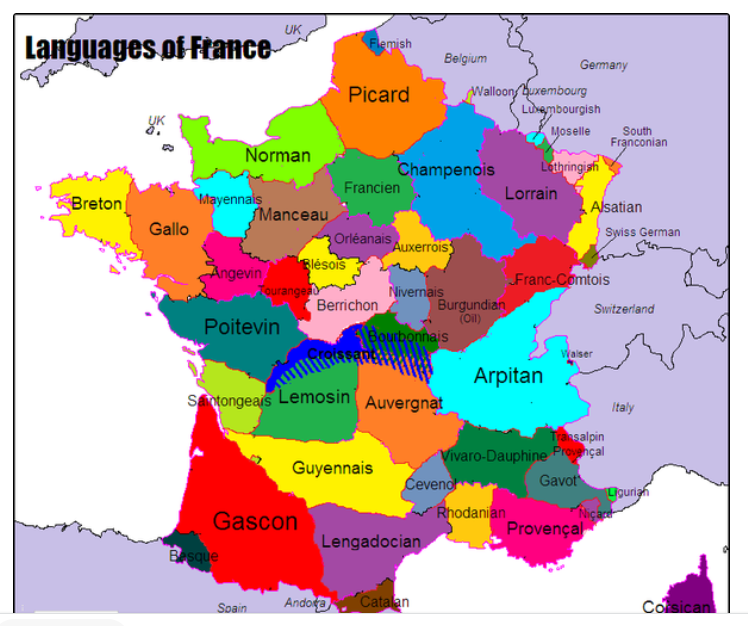
Tomaz starts his comments with a helpful map that illustrates the chaotic linguistic situation obtaining in France at the time, when there were dozens of different dialects, not all mutually comprehensible.


What madness !!!!!

Tomaz comments, "This map [above] is how approximately France looked linguistically at the time. You have over 40 different languages and dialects spoken in various regions of the country. Modern-day French was only established by Louis XIII and Louis XIV, and based on a language spoken by French nobility. It was established as the language of the whole French population only during the French revolution. 

At the time of the Normans, language was just something folks spoke, and if the peasants spoke a different language from the nobles you called that a Tuesday. Most of the nobility solved the problem by learning the language of the commoners they ruled, and some commoners would learn the language of their liege lords and that was that. No one was bothered by it, it’s just how the world worked at the time.

Plus the Normans [who invaded England] numbered 30 thousand men at most and many of those wanted to return to their homesteads in Normandy. On the Anglo-Saxon side, Harold Godwinson could have mustered a hundred thousand men if given enough time, but he was pressured to act hastily at Hastings.

Also, there was no “English language” at the time. This is how the Lord’s prayer “Our father” looked like in Anglo-Saxon:

Fæder ure
ðu ðe eart on heofenum
si ðin nama gehalgod
to-becume ðin rice
geweorþe ðin willa on eorðan swa swa on heofenum.
Urne ge dæghwamlican hlaf syle us to-deag
and forgyf us ure gyltas
swa swa we forgifaþ urum gyltendum
ane ne gelæde ðu us on costnunge
ac alys us of yfle.

Note: ð is read as “th”, as in ðis = this; þ is similar, þe = the

I’m not a linguist, but it looks closer to Swedish than modern-day English to me!"

Thanks for that illuminating post, Tomaz, and for your refreshing directness. I hope to see you on quora again soon. Don't leave it so long next time haha!

16:00 The U3A zoom meeting ends, and I feel completely drained, like I always do after one of Lynda's meetings. I try and unwind with a cup of Earl Grey tea and a Chelsea bun on the sofa with Lois. 

20:00 We settle down on the couch and watch a bit of TV, the latest programme in the series "The Hotel Inspector", where presenter Alex Polizzi visits failing hotels and restaurants and tries to give them advice on how best to start making a profit.


Quite an odd programme tonight. Middle-aged couple Sean and Janine run a back-packers hostel for millennials in Bude, Cornwall, the UK's 'surfing capital'. But they are averaging only a 16% occupancy rate, despite being the only hostel in town. So what's going wrong?

Presenter Alex Polizzi soon sorts out the low occupancy problem, by modernising the decor, then organising some remarkably photogenic millennials to come and be photographed there, with the pictures finally being plastered all over social media.

Trendy "octopus-themed" walls and a bunch of photogenic millennials 
can work wonders on social media advertising!

But Alex doesn't seem to notice fully what Sean and Janine's real problem is - i.e. that the only time they get any privacy is when they're in bed (in the garage), and even then.... [phrase copyright: George Harrison]. This poor middle-aged couple have to share kitchen, dining-room, lounge with the back-packers and deal with the youngsters' constant requests for information about buses, trains etc. My god!

After Alex and the TV cameras leave, Sean and Janine decide to sell up. And they get the last laugh: not only do they get a much better price for the building after all the modernisation work, but also they manage to sell the place just before the pandemic hits!

Kudos, Sean and Janine haha!!!

22:00 We go to bed - zzzzzzzzz!!!!!


Thursday, 1 July 2021

Thursday July 1st 2021

10:30 Lois goes out for a walk on the local football field, and she takes her phone with her, which is nice. I've been trying to encourage her to take more pictures, including selfies, to try and master the techniques involved. Good selfies are really difficult to achieve, I think.

She doesn't take any selfies today, as it turns out, but there are some interesting studies nonetheless.

this study is entitled "bashful bee"

this one is called "lonely crow"

ditto, with the lonely crow highlighted by my graphics team (i.e. me)


the parish council's idea of a meadow: an area
of the field that they aren't mowing, as a "nod" to local wildlife

Not bad are they! She's really coming on, I think.

While Lois does her walk, I do the exercises that Connor, my NHS physiotherapist has scheduled for me today, the so-called "List B".

14:30 We start the fortnightly meeting of our U3A Danish Group on Skype. Unfortunately Scilla, the group's Old Norse expert, can't join us today, but luckily there aren't any Viking references in the passages of Danish "Scandi-noir" crime novel, that we go through today, which is nice.

As usual the social chit-chat (in English) takes up most of the 1 hour 45 minutes of the meeting, and that's fine. In lockdowns and pandemics people don't get enough interaction, so it's nice to stock up on banter and old codger-talk, mostly news about children and grandchildren. 

The saga of Joy's daughter continues: she works for a company in Singapore but in the last year or so she's been working remotely from the UK and Portugal because of pandemic issues. While away from Singapore, she made the decision to keep paying the rent on her flat in Singapore: £900 a month for basically a one-room flat, with shared kitchen and bathroom; what madness, sheer extortion!!!! She kept the rent payments up, paying them each month, hoping to be able to go back to live there in Singapore when the pandemic was over, but now the owner is selling the building, so Joy's daughter has lost thousands of pounds to no good purpose. What a crazy world we live in !!!!

16:15 The meeting ends and Lois and I feel totally drained, as always after one of our Danish meetings. We try to wind down with a cup of Earl Grey tea and a current bun on the patio. The sun has come out, which is nice.


we relax with a cup of Earl Grey tea and a currant bun on the patio

16:30 I look at my smartphone. I'm pleased to see that one of our favourite Quora forum pundits, Stephen Taylor, has been weighing in on the vexed question of whether there's a "posh" American accent or not. 


Taylor writes, "I think there were several [posh American accents]. Emphasis on “were,” because these accents are on the verge of extinction now. I occasionally still hear them, but they’re so rare, your ears prick up.

George Plimpton (1927-2003) had the classic patrician upper-class New York accent, which if you didn’t know him, would make Plimpton automatically sound like a snob — except he wasn’t. (Plimpton was largely a sports writer, writing about baseball, the NFL, and Muhammad Ali.) It’s odd to listen to a man who sounds so much like an American “aristocrat” doing commercials for Mattel. Some Americans assume this is a “British” accent. (It isn’t.)

George Plimpton doing a sports report

Plimpton’s accent is actually a toned-down version of the almost foreign “Boston Brahmin” accent.

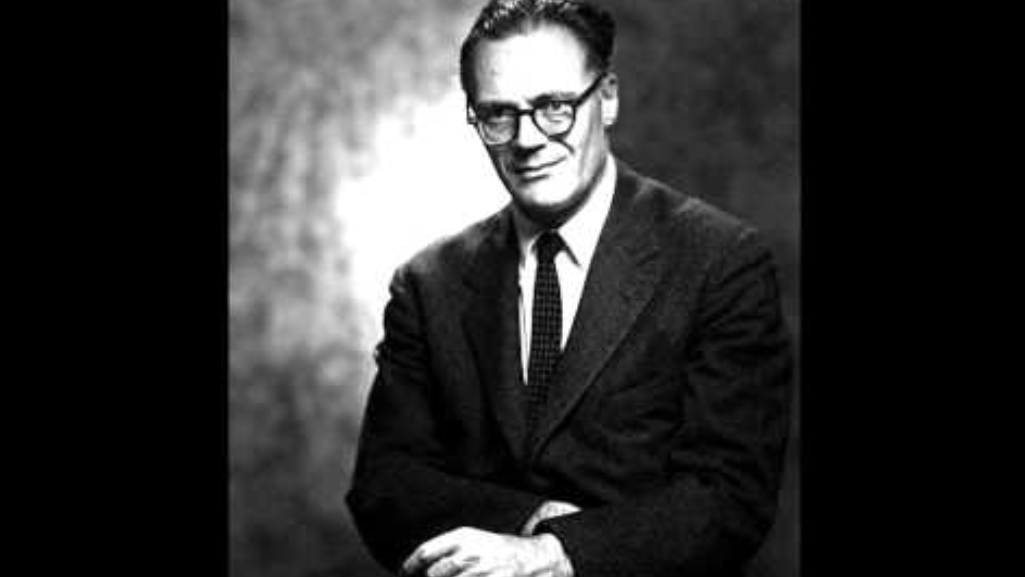
Believe it or not, the Boston Brahmin accent (as far as I know, rare even in Boston today) actually tried to adopt some of the “old plantation South accent,” even though Boston isn’t the South. This was a huge affectation, not a natural development. It was most noticeable in Bostonians like the poet Robert Lowell (1917–1977), who spent some time in Tennessee and Louisiana and admired Southern poets. This wasn’t a typical New England accent, and definitely nothing at all like a stereotypical Boston accent.

Robert Lowell

In fact, it had more in common with the way poets like John Crowe Ransom and Robert Penn Warren read their poetry. For some reason, Southern accents aren’t considered “posh,” but much of the “upper-class plantation” accent, where some Southerners learned to say “wah” instead of “war,” was part of trying to deliberately sound more like Victorian Britons (not very successfully).

You can hear some of this Southern “posh-ness” in the way Robert Penn Warren said words like 'are' and 'there', 'mirror' and 'air', 'water' and 'cellar'. There are many accents in the American South, but most Southerners have never talked like this, not even in Warren’s native western Kentucky:

Then there were Americans who deliberately tried to sound more “English.” Some of these Americans actually spent a lot time in England, where the accent rubbed off. (T.S. Eliot, who grew up in St. Louis, sounds about as English to me as Winston Churchill, whose mother was from Brooklyn.)

William F. Buckley, Jr., was another great example of this “cosmopolitan” American accent. Buckley was a New Yorker, but his mother was from New Orleans, he grew up partly in Mexico (English was actually Buckley’s third language), so in the act of being free of a “local” New York accent, he adopted the “transatlantic” accent — though tinged with a little Southern drawl. [??? - Ed]

T.S. Eliot was born in Missouri — but to a “Boston Brahmin” family. Then he moved to England when he was 25. I’m not sure whether he learned to talk like this in St. Louis or at Oxford, but it’s obviously a far cry from a typical Missouri accent:

If “posh” equals “sounding more like an upper-class person from England,” then there were plenty of Americans who did that. But that cultural urge died out by the 1960s, possibly once Americans had proven that you didn’t need to be English to be “cultural.” At the same time as some Americans were cultivating these accents — which are admittedly beautiful, in their own way — others were deliberately rejecting them. 

For all the talk about racial struggle in America, Americans often go out of their way to emphasis what class they belong to (or want to belong to). And often that means by not sounding “English,” which is often (stereotypically) equated with being “posh,” despite the amazing array of accents in the U.K. (For the record, the same thing happens in the U.K. itself. With probably 20 major accents and some lesser known ones, millions of Britons emphasis their class by speaking in a particular way.)

The “non-posh” Midwestern accents now predominate in America. It’s been said that the “standard American” accent today is an Ohio accent. The U.S. has a huge historical diversity of English-language accents. But if what’s said is true, then we’re all slowly being Ohio-ized.

Fascinating stuff !!!! But jolly complicated!

Lois and I wonder what accent it is that TV presenter Loyd Grossman has - is that 'Boston Brahmin'? We're not sure, but we think we should be told!

18:00 Our 10-year-old grandson Isaac has been performing in a musical, "The Big Bad Wolf" at Haslemere Hall, Surrey, today, but we'll have to wait to hear how that went. He's got one of the starring roles as the Big Bad Wolf, and will be singing a solo song.

Our 7-year-old twin granddaughters in Australia, Lily and Jessie, feel a special bond with Isaac, because they all share a birthday, later this month. Earlier today Jessie texted us to ask what's happening here today, so I told her about Isaac's big day.

texting with Jessie, our granddaughter in Australia

It's one of the pleasures of mine and Lois's "grandparent-hood" that we get texts from all our five  grandchildren now. We got this cute little text from Lily in Australia yesterday.

...and texting with Lily

Is it not worth all the money in the world to.... [Don't even think about saying that again! - Ed]

20:00 Lois and I settle down on the couch and watch a bit of TV, an interesting documentary about the Bronte sisters, presented by broadcaster Gyles Brandreth.


This is an hour's pleasant and undemanding viewing, with lovely views of the Yorkshire moors, where the three Bronte sisters lived their lives. They didn't really travel a lot anywhere else, so their incredibly successful books mainly come out of their little Yorkshire moor world, plus their imagination. 

It's fascinating tonight to see, for example, a hall with what was clearly the inspiration for "Cathy's window" (see 'Wuthering Heights'), and another hall with a little attic room where a real life woman called "Mad Mary" was incarcerated (see 'Jane Eyre').

The three sisters, like Victorians in general, were obsessed with mental illness, and this was the period when pseudo-sciences like phrenology began to be popularised. I guess the Brontes didn't have to look very far to find the sort of mental illness that would inspire some of the characters in their novels: not just the local madwoman "Mad Mary", but their own brother Branwell, who had plenty of issues on the mental front, to put it mildly. My god!

the attic room where local madwoman "Mad Mary" is believed
to have been incarcerated: the probable inspiration for
Bertha Mason, Rochester's first wife, in "Jane Eyre"

The sisters would have been amazed to see how their books have travelled the world since their deaths, enthusing readers from quite different cultures from Yorkshire's, that's for sure. And the popularity of Kate Bush's tribute single "Wuthering Heights" (1978) remains strong, even after 40 years, no doubt about that, either! 


synchronised "Kate Bush Wuthering Heights-dancing" 
Can it finally become an Olympic sport?, I ask myself.
I don't know, but I think we should be told!

22:00 We go to bed - zzzzzzzzz!!!!!